The Red Handfish: Tasmania's Rarest Walking Fish Gets a Lifeline
Tasmania's critically endangered red handfish faces an uncertain future. A release of 65 captive-raised fish and new seagrass restoration work offer cautious hope.
Australia | Wildlife & Conservation | 22 November 2026
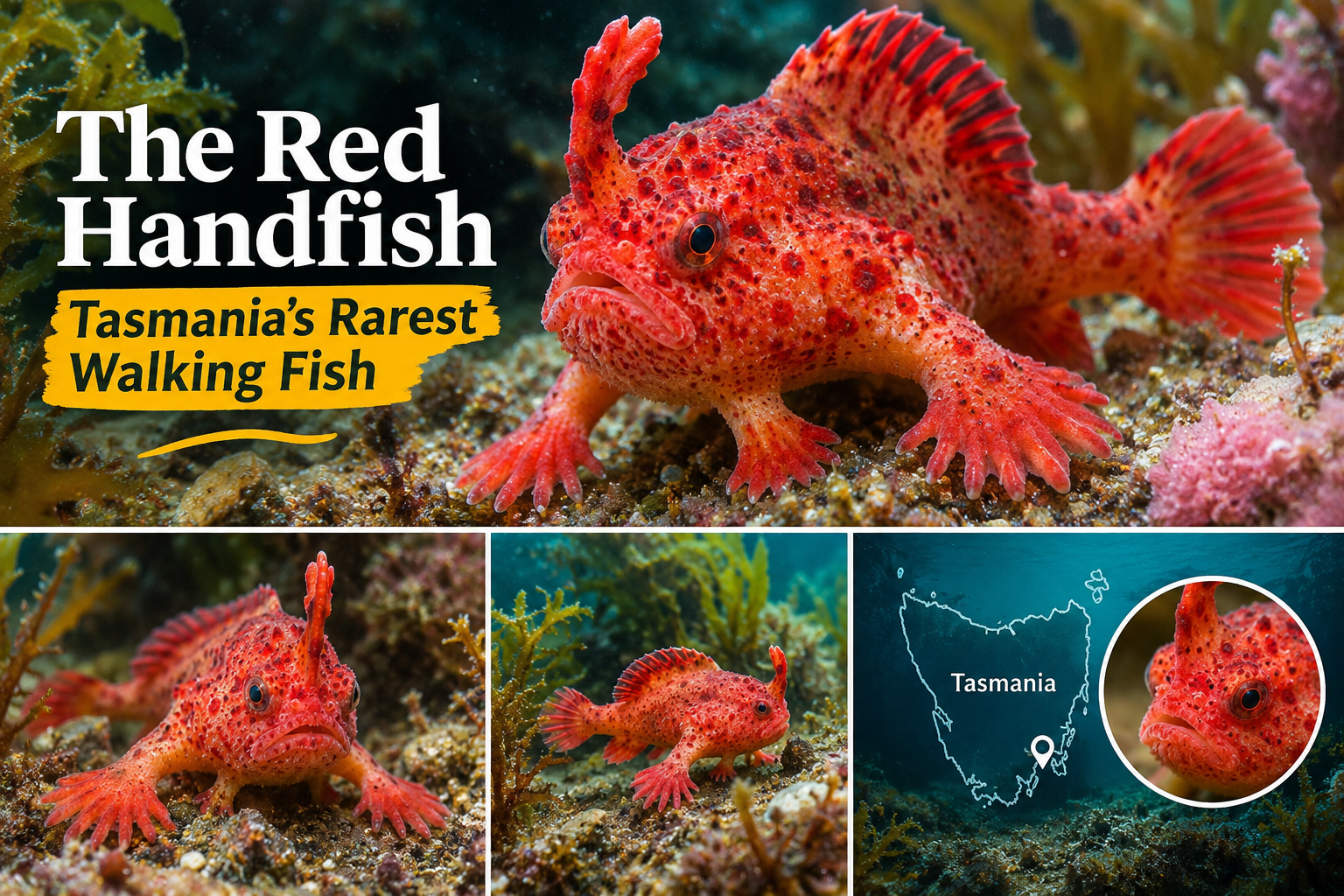
Hidden beneath the shallow coastal waters of south-east Tasmania lives one of Australia's rarest and most unusual fishes. The critically endangered red handfish (Thymichthys politus) uses its modified fins to walk across the seabed rather than swimming long distances.
Its known wild population occupies a tiny area, leaving it vulnerable to habitat damage and extreme marine conditions. But conservation breeding, a release of 65 captive-raised fish in 2025, and new habitat-restoration work in 2026 offer cautious hope for its survival.
What is a red handfish?
The red handfish is a small marine species that usually grows to around six centimetres. It has a broad head, a stocky body and enlarged pectoral fins that help it move across the seafloor.
Some individuals are strikingly red; others are mottled with pink, orange or brown, with red edging on their fins. The fish can swim, but walking is its characteristic way of moving through its shallow-water habitat.
This unusual movement is part of the challenge conservationists face. Unlike fish that travel long distances through open water, red handfish generally remain close to suitable patches of seabed. When that habitat deteriorates, moving elsewhere is difficult.
Where does this rare Tasmanian fish live?
Red handfish are native to Tasmania, with the surviving known wild population concentrated around Frederick Henry Bay, south-east of Hobart. Dodges Ferry and Primrose Sands are important historical and conservation locations.
The habitat includes shallow rocky reef, seaweed and seagrass. These plants provide shelter and places where fish can attach their eggs.
The species' distribution is so restricted that small local changes can have major consequences. Importantly, historical references to two wild populations should not be assumed to describe two healthy populations today. Government records indicate that the Primrose Sands population was considered locally extinct after 2023, with captive-raised animals later released into the area.
How many red handfish remain?
The red handfish is listed as Critically Endangered under Australian environmental legislation.
The Australian Government's threatened-species material cited an estimate of fewer than 100 wild fish in 2022. More recent University of Tasmania communications have referred to fewer than 250 in the wild. These figures come from different years and assessment methods and should not be treated as a measured population increase.
They are also separate from fish held in breeding facilities. In July 2026, conservation organisation FAME reported that the captive population had grown to more than 300 fish.
Captive breeding provides an important safeguard, but a large captive population is not the same thing as a stable, breeding population in the wild. There is no verified November 2026 census establishing an exact wild total.
A major milestone: 65 handfish released into the sea
In October 2025, the University of Tasmania's Institute for Marine and Antarctic Studies (IMAS) announced the release of 65 captive-raised red handfish into Tasmanian waters.
This was a significant achievement after years of work learning how to breed the fish, raise young animals and prepare them for release. Scientists must still monitor the released fish to understand survival, movement and eventual breeding.
A release is an important conservation step, not proof that the population is now self-sustaining.
Inside the Handfish School
The breeding program includes a practical initiative known as the Handfish School, which prepares captive-raised fish for conditions they will encounter in the sea.
A November 2026 report by Equity Trustees described how young fish experience features such as artificial seaweed, natural invertebrates and moving water. These are intended to encourage useful behaviours before release.
The program has reported more than 450 hatchlings over its first three years. FAME also reported 89 juveniles produced during a successful breeding period in late 2025.
These numbers show the progress of conservation breeding, although they do not mean all hatchlings survived or were returned to the wild.
Why breeding them is difficult
Red handfish females lay clusters of eggs and guard them. Their young hatch as miniature fish rather than drifting as planktonic larvae over long distances.
That limited natural dispersal helps explain why populations become isolated and why genetic diversity matters. Breeding and release programs must carefully consider both the animals' health and their long-term capacity to reproduce.
What threatens the red handfish?
Loss of seaweed and seagrass
Seaweed, seagrass and other marine vegetation are essential components of the handfish's environment. Heavy grazing by sea urchins can remove underwater cover and leave parts of a reef unsuitable.
Habitat degradation can also follow sediment runoff, pollution and coastal disturbances. Because red handfish move relatively little, they are especially vulnerable to local habitat loss.
Marine heatwaves
Increasingly warm ocean conditions are another concern. During the unusually warm 2023–24 summer, researchers temporarily removed 25 red handfish from the wild as an emergency protective measure.
The intervention illustrates how serious marine heatwaves may be for a fish with very little room to escape changing conditions.
Human impacts
Damage from anchors, disturbance to the seabed and pollution can affect the marine vegetation the fish depends on. Protecting a few small patches of habitat requires sustained care, not just occasional interventions.
July 2026: a seagrass restoration nursery opens in Tasmania
A promising development arrived in July 2026, when Tasmania's first dedicated seagrass restoration nursery was launched at IMAS in Taroona.
Supported by the Australian Government's Saving Native Species program, the facility is designed to improve the propagation and restoration of seagrass.
The nursery is important because protecting the fish alone is not enough. Conservationists must also help restore the underwater habitat needed for shelter, feeding and reproduction.
Healthier seagrass meadows can benefit a wider variety of marine organisms, potentially making this a project with value beyond the red handfish.
Can conservation work bring the species back?
The recent progress is encouraging. Hundreds of hatchlings have been produced, 65 captive-raised fish have been released, and habitat restoration is expanding.
But a successful recovery will ultimately require wild fish that survive, reproduce, maintain genetic diversity and persist without constant emergency intervention.
Scientists still need to establish how well released animals survive over time and how effectively restored habitats support breeding. As of November 2026, the species remains Critically Endangered.
There is a meaningful difference between reducing the immediate risk of extinction and restoring a secure wild population.
How Australians can help
Support legitimate conservation organisations such as the Handfish Conservation Project and FAME. Protect seagrass and reefs when boating, diving or snorkelling, dispose of fishing line and rubbish responsibly, and avoid disturbing or collecting protected marine wildlife.
Sharing accurate information can also help build public support for the long-term research and habitat management this species needs.
A tiny fish with a much bigger story
The red handfish is only a few centimetres long, yet saving it requires enormous dedication.
The 2025 release and the new 2026 seagrass nursery do not guarantee survival. They do show how science, conservation breeding and habitat restoration can come together to give an exceptionally rare animal a better chance.
For Tasmania's tiny walking fish, the next chapter is still unfolding beneath the waves.
Sources and references
- Australian Government — Red handfish recovery profile
- University of Tasmania — Scientists release captive-raised red handfish into the wild (2025)
- FAME — Tasmania's first seagrass restoration nursery (July 2026)
- FAME — From saving a species to restoring an ecosystem (July 2026)
- Equity Trustees — The conservation experiment giving the rare Handfish a fighting chance (10 November 2026)
- Tasmanian Government — Red handfish species information
- Handfish Conservation Project
Read more at AussieBoomer and The Rift Report.
Original research-based editorial content © 2026 AussieBoomer.com. Images, where added, require separate credit. Corrections can be requested through AussieBoomer.com.
Sources & References
- Australian Government — Red handfish recovery profile — DCCEEW (Background)
- Scientists release captive-raised red handfish into the wild — University of Tasmania (October 2025)
- Tasmania's first seagrass restoration nursery — FAME (14 July 2026)
- From saving a species to restoring an ecosystem — FAME (16 July 2026)
- The conservation experiment giving the rare Handfish a fighting chance — Equity Trustees (10 November 2026)
Corrections & Updates
Population figures are estimates from different dates and methods; long-term survival of released fish remains unverified.