New Rapid Test Offers Hope for Tasmania's Devils
Tasmanian researchers have developed a portable DNA-based test for devil facial tumour disease. Early field trials show promise, but detecting infection before visible tumours remains a research goal.
Tasmania | Wildlife & Conservation | 18 November 2026
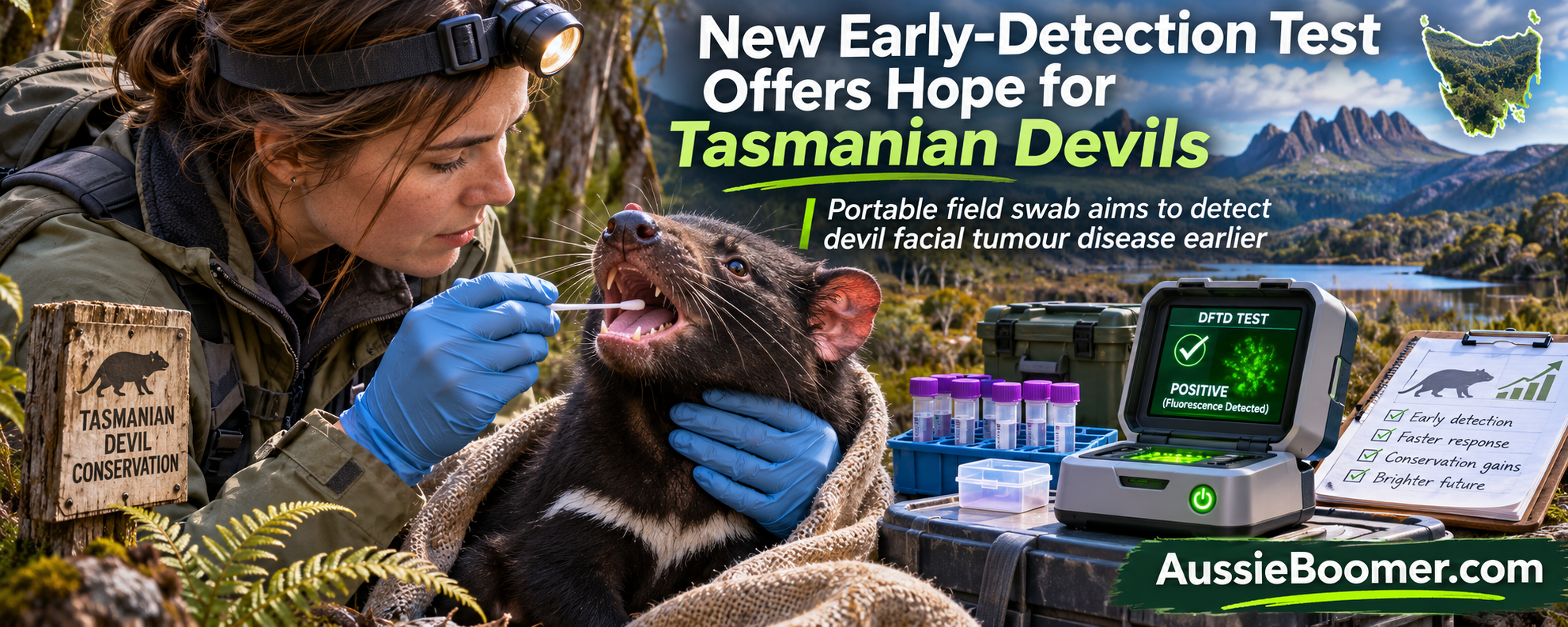
A new portable test developed by Tasmanian researchers could make it much easier to identify devil facial tumour disease (DFTD) in wild Tasmanian devils — an important advance for a species devastated by contagious cancer.
The early findings are encouraging. But there's an important distinction: the researchers have shown that the test can detect tumour DNA from field-collected samples. They have not yet proved that it can reliably diagnose disease before visible tumours appear.
A faster answer in the field
A team led by Anuk Kruawan at the University of Tasmania's Menzies Institute for Medical Research has adapted a DNA-detection approach known as SHERLOCK for the two distinct transmissible devil cancers, DFT1 and DFT2.
The technique combines amplification of genetic material with CRISPR-based recognition of tumour-specific DNA. When the target is detected, a fluorescent signal can be seen using portable equipment.
Unlike conventional tests requiring specialised laboratory facilities, the approach is designed to work much closer to where wildlife teams are monitoring animals. According to reporting on the study, processing can deliver a result in roughly an hour, although that does not include trapping or handling the animal.
The full research was published in Royal Society Open Science in November 2026.
What the first trials found
The team collected 33 samples from 10 wild Tasmanian devils and three spotted-tailed quolls in northern Tasmania.
Five devils with suspected tumours tested positive for DFT1. The quolls, used as controls, did not test positive. The researchers also investigated the test's ability to identify DFT2 using other samples.
Importantly, this was an early, relatively small field evaluation, not a finished statewide screening programme. Further validation is needed, particularly in apparently healthy animals.
Researchers hope to test devils repeatedly before tumours become visible, then follow them over time to determine whether earlier detection is possible.
Why this matters for Tasmania's devils
Devil facial tumour disease is no ordinary wildlife illness. It is a form of contagious cancer, with living cancer cells passing between devils, commonly through biting.
Tumours can grow around the mouth and face, making eating increasingly difficult. In some areas, populations have declined by about 80 per cent, highlighting the enormous pressure this disease has placed on the species.
There are two separate transmissible cancers, DFT1 and DFT2. DFT1 has spread much more widely, while DFT2 has been detected in a more restricted part of southern Tasmania. Conservation teams need to monitor both.
A reliable, practical field test could help researchers map disease spread, distinguish tumour types and track changes in wild populations more quickly.
Could this lead to a vaccine?
That's one of the exciting longer-term possibilities, but a vaccine is not what this new test delivers.
The research team is also working on an oral bait vaccine. Better monitoring could eventually help scientists understand how infection develops, how the immune system responds and how future vaccination or treatment trials might be assessed.
For now, the new diagnostic is a tool for research and surveillance. It is not a cure or a demonstrated way to stop transmission.
A promising step — and a reason to keep going
At AussieBoomer, we're passionate about Australian wildlife, biodiversity and protecting animals from suffering.
So it's encouraging to see locally led Tasmanian science tackling one of the biggest threats to a truly remarkable native species. The strongest message isn't that devils have been saved overnight — it's that researchers may soon have a better way to understand and monitor the disease threatening them.
That matters for the devils, for conservation workers and for the future of Tasmania's wildlife.
A little more knowledge today could make a real difference tomorrow. 🐾
For more about Australian wildlife and our developing community, explore AussieBoomer and The Rift Born.
Editorial image note: Any AI-generated illustration used with this story should be labelled as an illustrative reconstruction, not a photograph of the actual research or a confirmed clinical result.
Sources & References
- Development of a point-of-care field test for Tasmanian devil facial tumour disease — Royal Society Open Science / PubMed (Published online 11 November 2026)
- Researchers hope new test can detect deadly Tasmanian devil facial tumour disease in the field — ABC News — Rani Fletcher (12 November 2026)
- Rapid test speeds up devil facial tumour disease detection — ConnectSci — Imma Perfetto (17 November 2026)