Scientists Find 245 Animals Living Inside One Deep-Sea Rock!
Scientists have discovered 4,139 tiny animals living in the cracks of 244 deep-sea nodules, including 245 in a single rock. The finding raises questions about potential mining.
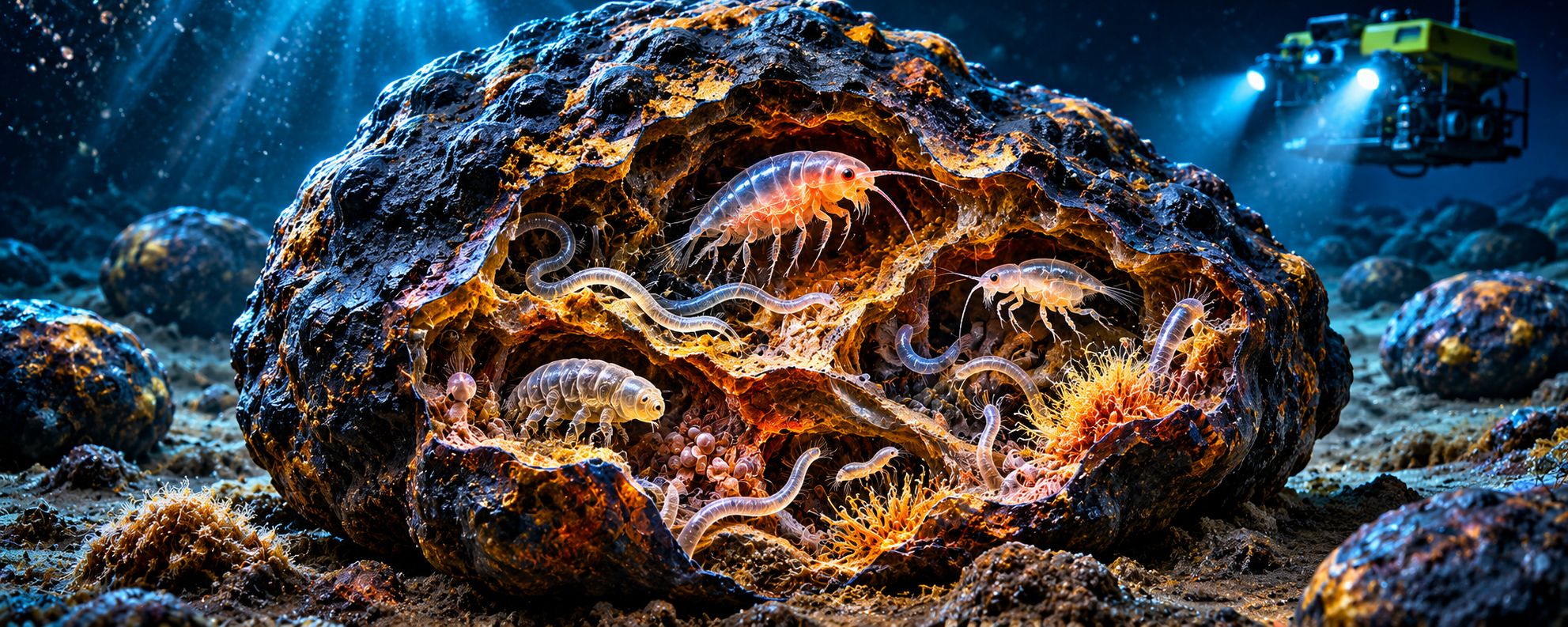
Imagine picking up a rock and discovering a miniature neighbourhood living inside it.
Not just one or two creatures. One deep-sea rock held 245 individual animals.
It sounds like a mystery from another world, but scientists have uncovered these remarkable communities in the depths of the Pacific Ocean. And their discovery raises an urgent question: what happens to the residents if their ancient homes are mined?
The hidden world inside a rock
Thousands of metres below the surface, the Clarion-Clipperton Zone in the central Pacific is dotted with dark, lumpy polymetallic nodules. These formations are rich in metals including manganese, nickel, cobalt and copper.
They also grow extraordinarily slowly — on geological timescales measured in millions of years.
From the outside, a nodule might look like a dull stone. Under closer examination, though, it contains tiny crevices and cavities. Those spaces can shelter animals less than a millimetre long.
To us, a crack in a rock is almost invisible. To a tiny animal, it can be an entire home.
4,139 animals across 244 nodules
An international research team examined 244 nodules from the deep Pacific and recorded 4,139 individual animals living in their crevices.
On average, researchers counted approximately 17 animals per nodule. But the most crowded specimen housed an extraordinary 245 individuals.
That's 245 animals in a single rock — not 245 different animal species.
Among the tiny inhabitants were nematodes, microscopic roundworms, and copepods, small crustaceans that are an important part of many marine ecosystems.
The findings were published in the peer-reviewed journal Scientific Reports on 11 November 2026. The study, led by researchers including Coral Diaz-Recio Lorenzo and Tanja Stratmann, reveals that the nodules offer more than a hard outer surface. Their internal cracks form additional three-dimensional habitat.
Why these creatures are different
The research also found that the communities inside the nodules differed from those inhabiting the surrounding soft seabed sediment.
That matters. It means the animals aren't simply using the rocks as a convenient stopover; the cracks and cavities provide distinctive living conditions.
Some of the communities remained surprisingly similar at research sites separated by distances of up to 1,000 kilometres.
Scientists still need to investigate how widely particular species are distributed and whether some depend heavily on these structures.
In other words, a nodule isn't just a lump of metal-rich rock. It may be a miniature ecosystem that cannot easily be replaced.
The deep-sea mining dilemma
Polymetallic nodules have attracted interest because they contain metals used in modern technologies.
But harvesting nodules from the seabed would also remove the habitats formed within them.
And here's the difficult part: these formations take millions of years to grow. They won't be replaced within the lifetimes of the creatures living there — or our own.
The new study highlights the risk of losing poorly understood biodiversity through potential commercial mining. That does not mean researchers have proved every nodule-dwelling species faces extinction. Their wider distribution and ecological dependence still need investigation.
It does mean environmental decisions need to account for life inside the rocks, not just the animals seen above them.
What scientists need to discover next
Researchers are continuing to investigate nodule-associated habitats in the Clarion-Clipperton Zone.
Several questions remain open. Are some creatures found only in these crevices? How do the communities spread between distant nodules? And how might proposed mining activities affect the tiny animals that help make the deep ocean so diverse?
The answers will matter for evaluating environmental risks and designing meaningful protections.
AussieBoomer's view: small life matters, too 🐾
At AussieBoomer, our passion for conservation doesn't stop with familiar Australian animals such as Tasmanian devils.
Biodiversity includes the unusual, the overlooked and the almost impossibly small.
It's tempting to think that conservation is only about saving the animals we can see. But this discovery reminds us that extraordinary life can exist in places we barely understand.
We believe it makes sense to study these habitats carefully before taking actions that could permanently remove them. It's possible to recognise the economic interest in seabed metals while also taking the ecological risks seriously.
Because protecting biodiversity means caring about the life we know — and the life we're still discovering.
One rock. Hundreds of lives. A bigger mystery.
A deep-sea nodule doesn't look much like a home.
Yet one held 245 animals, and the wider study found thousands of tiny inhabitants inside these ancient formations.
What other remarkable worlds are hidden in the unexplored ocean?
That's the wonder of science: every discovery opens another door.
Stay curious, Old Mates. The greatest adventures sometimes begin with the smallest creatures! 🌊
The featured artwork for this article, when added, is an AI-generated conceptual illustration. It is not a photograph of the study specimens or the research expedition.
Explore more on AussieBoomer
Follow the community
Sources & References
- Polymetallic nodules provide a distinct habitat for abyssal meiofauna — Scientific Reports (11 November 2026)
- Hidden Worlds in the Deep Ocean — MARUM — University of Bremen (11 November 2026)
- Hidden ecosystem: Scientists discover 245 animals living inside a single deep-sea rock — ScienceDaily / MARUM (16 November 2026)